Why Most Branded Worlds Lose Their Audience
Launch media can fill a virtual world once. Only a game loop, persistent progress and a live operating rhythm can make people choose to return.
Analysis by Tu Dang · Founder of ROLearn
Published · Updated · 9-minute read
Key findings
- A visit proves that acquisition worked. Retention shows whether the experience created a reason to choose it again.
- The most common failure is structural: the world is built as a finite campaign destination but expected to perform like a live game.
- The retention system should join the brief before production: fast first fun, a repeatable loop, persistent progress, social utility and an owned update calendar.
- Cohorts, not lifetime totals, reveal whether design changes improve return behavior or simply add another launch spike.
Opening night is the most flattering moment in the life of a branded world. Creators are streaming, paid placements are live, the press link is fresh and every stakeholder is watching the concurrent-player count climb. Then the campaign stops pushing. The crowd thins. Within weeks, the same expensive space can feel like a trade-show booth after everyone has gone home.
That is usually described as an audience problem. It is more often a product problem that acquisition temporarily concealed.
Roblox tells creators to improve Day 1 retention and average session time before driving too many new users, then to watch Day 7 and Day 30 retention for evidence of longer-term progress. Epic defines Fortnite island engagement through time played and return behavior, and says Discover evaluates playtime, retention, quality play-through and social signals continuously. The platforms are making the same point in operational language: distribution follows player satisfaction more reliably than spectacle follows a media plan.
Marketing can deliver a first session. It cannot manufacture a second choice.
The metric that hides the failure
Lifetime visits are cumulative. They can only rise, which makes them reassuring and almost useless for diagnosing decay. A million launch-week visits remain a million visits even if almost nobody returns in week three.
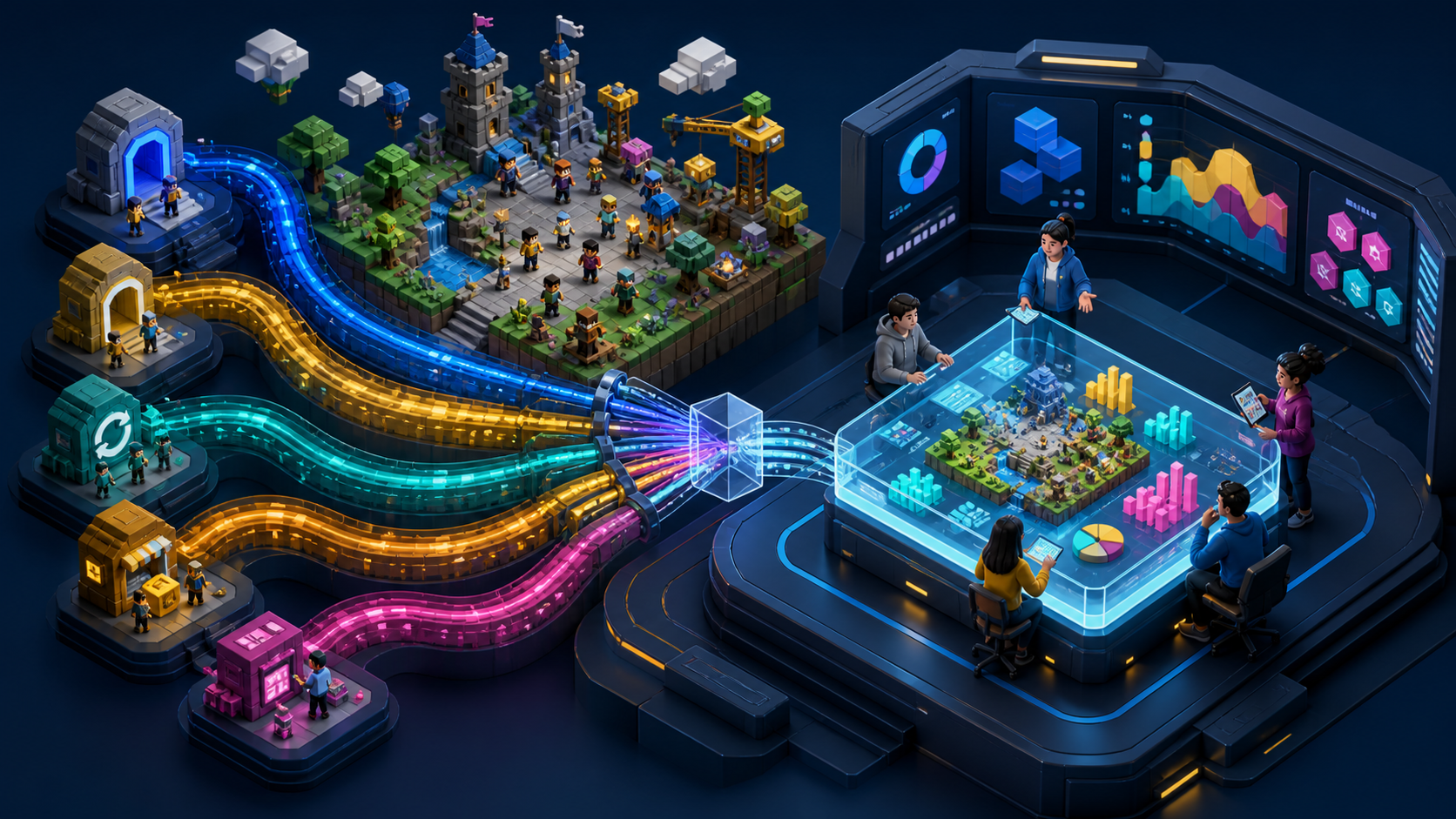
Retention asks a harder question: of the people who first played in a defined period, how many came back after one day, one week or one month? This cohort view separates the audience recruited by each launch beat and shows whether the experience did enough to earn another session.
That distinction changes the meeting:
- Visits ask whether the campaign drove arrival.
- Early exits and first-session completion ask whether players reached the fun.
- Day 1 return asks whether the first visit created unfinished intent.
- Day 7 return asks whether progression, competition or social plans survived the week.
- Day 30 return asks whether the world became part of a player’s rotation.
A branded experience does not need the retention profile of an endless role- playing game to succeed. A three-day product reveal and a persistent community world have different jobs. The mistake is setting a long-lived ambition while building a one-session product, then using visits to make the mismatch disappear.
Five reasons the audience leaves
1. The experience is a place, not a loop
A beautiful lobby, gallery or replica store answers “where am I?” It does not answer “what do I do next?” Once every room has been seen and every screenshot has been taken, the content is exhausted.
A loop links action, feedback and another meaningful choice. It might be a cooperative challenge, a fashion composition, a timed build, a collection hunt with changing routes or a competitive mastery system. The specific mechanic matters less than the repeatable promise: returning should produce a different decision, not the same tour.
2. The first fun arrives after the first exit
Branded worlds often begin with exposition, portals, legal copy and a long walk through impressive architecture. Players experience those minutes as friction. Roblox’s retention guidance recommends getting new users to the fun quickly, ideally within five minutes. That should be treated as a ceiling, not a target.
The first minute needs a clear verb, visible feedback and a credible next reward. Story can deepen after agency begins. If players need a presentation before they can play, many will leave during the presentation.
3. Nothing belongs to the player
People return to protect or advance something they recognize as theirs: progress, status, a collection, a customized identity, a relationship or a promise made to friends. A one-time badge can help recall, but persistence becomes powerful when it changes the next session.
This is why a cosmetic should not be treated only as a redemption count. Does the player equip it later? Does it travel outside the activation? Does it unlock a new choice? Persistent utility turns a souvenir into a reason to remember.
4. The world has a launch date but no operating owner
Games are services after release. Campaigns are often handed over after release. That organizational gap appears inside the product as stale quests, unresolved bugs, empty event spaces and no response to the behavior visible in week one.
Roblox’s creator guidance connects longer-term retention with progression, endgame, social mechanics and regular updates. The exact cadence should match scope, but the principle is universal: a live world needs a decision-maker who can change it after players arrive.
5. The audience cannot create the next audience
Friends reduce the cost of deciding what to play. A social world with no party reason, shared objective, expressive status or creator-friendly moment loses that advantage. Epic explicitly includes social play among the signals evaluated for Discover. Roblox encourages event and invite mechanics as acquisition tools.
The useful question is not “can this be shared?” Everything can be shared. Ask what happened that a player would want to show, and what a friend can do when they arrive.
Diagnose the leak before buying more traffic
Use the full player retention analytics framework to define the cohort, segment acquisition and version effects, locate the first evidence-backed break and test the intervention.
| Observed pattern | Likely question | Next test |
|---|---|---|
| High detail-page traffic, low play-through | Does the promise match the experience? | Test icon, title and description against the real first minute |
| Many joins, exits in the opening minutes | Is the path to first fun too slow or unclear? | Remove exposition, shorten traversal and instrument the first meaningful action |
| Healthy first session, weak Day 1 return | Did the session leave any unfinished intent? | Add a visible next goal, saved progress or a social commitment |
| Day 1 holds, Day 7 collapses | Does progression remain interesting after novelty? | Rebalance pace and introduce a changing challenge or collection layer |
| Return is healthy, growth stalls | Can satisfied players recruit others? | Test party play, invites, creator formats and portable rewards |
| All cohorts fall after an update | Did performance, onboarding or balance regress? | Compare pre-update and post-update cohorts by device and acquisition source |
Do not compare one blended retention line before and after a media burst. A large influx of colder users can lower the average even when the product has not changed. Roblox’s documentation notes this exact cohort effect. Segment new users by first-play date, source, device, geography and campaign treatment. Then compare like with like.
Build the retention system into the brief
The most useful retention plan is written before the map is grey-boxed. It gives designers and marketers the same definition of success.
Before production, name the return promise in one sentence. Decide what persists, what changes and who owns live decisions. Specify the first meaningful action and the event that proves it happened.
Before launch, test the first session with people who have not seen the deck. Instrument the onboarding funnel, core loop, progression milestones, social actions, return visits and failures. Freeze cohort definitions before the media spend starts.
During the first 72 hours, repair blockers and confusing steps. Do not bury a broken first minute beneath more acquisition. Read qualitative feedback beside the funnel so you know what the drop-off means.
During weeks one and two, compare cohorts by source and creative promise. Ship the smallest change that gives returning players something new to notice.
During weeks three through eight, decide whether the world has earned ongoing operation. Continue, reposition or close it deliberately. An inactive branded world is still communicating something about the brand.
What marketers should put on the page
The executive view should show acquisition and product health together:
- unique new players and their sources;
- play-through from detail-page impression to qualified session;
- first-session completion and time to first meaningful action;
- Day 1, Day 7 and Day 30 retention by launch cohort;
- repeatable-loop participation, persistent-item use and social play;
- changes shipped, with the cohorts exposed to each version.
That page may be less dramatic than a lifetime visit total. It is much more valuable. It tells a studio where the experience loses people, tells a marketer which acquisition promises attract the right audience, and tells a finance team whether another burst of traffic will build an asset or refill a leaking room.
The branded worlds that endure are not necessarily the biggest on launch day. They are the ones that turn a borrowed audience into a continuing choice.
Sources
- Analytics, Roblox Creator Hub (accessed August 10, 2026)
- Retention, Roblox Creator Hub (accessed August 10, 2026)
- Acquisition, Roblox Creator Hub (accessed August 10, 2026)
- Engagement, Epic Games (accessed August 10, 2026)
- How Discover Works in Fortnite, Epic Games (accessed August 10, 2026)
Cite this piece
Tu Dang. "Why Most Branded Worlds Lose Their Audience." ROLearn Intelligence, July 28, 2026. https://intelligence.rolearn.dev/analysis/why-most-branded-worlds-lose-their-audience
About the author
Tu Dang is founder of rolearn. Tu Dang is the founder of ROLearn, a market-intelligence platform used by developers, studios, and brand teams working inside virtual worlds.