Brand Activation Measurement: How to Measure a Virtual-World Campaign
·18 min read
Virtual worlds now carry audiences, programming, attention and social distribution. The measurement system around them was built for placements that disappear when the media spend stops.
By Tu Dang · Founder of ROLearn
· 15 min read · Updated

A placement borrows attention from somebody else’s programming. A virtual world can become the programming.
That distinction is larger than a change in format. A branded game or persistent world can attract an audience, hold it through participation, give it reasons to return, produce stories for creators and distribute those stories across social video, live streams, communities and press. It can behave like a media property with an operating calendar, a fan base and a content engine.
Most reports still reduce that system to campaign-shaped numbers: impressions, visits, clicks and redemptions collected between launch day and the end of the paid-media flight. Those metrics are not wrong. They are incomplete in a predictable direction. They see the door and miss what the audience did after walking through it.
This analysis explains when a game should be treated as a media channel, which audiences that channel creates, how the measurement architecture changes and where marketers should resist the temptation to turn every minute or interaction into a financial claim.
A campaign asks how many people saw the launch. A media channel asks whether the audience chose the next episode.
Campaign measurement was designed around bounded delivery. A creative runs in a known placement, during a known period, against a purchased audience. The buyer expects reach, frequency, cost and an outcome associated with that exposure.
A virtual-world activation can contain those elements, but it can also contain a game loop, persistent identity, live programming, creator participation, community behavior and organic discovery. The experience may remain accessible after the paid support ends. A player may encounter it through a friend, return through platform recommendations and later watch a creator discuss it on another platform.
Calling all of this a campaign creates three structural mistakes.
The calendar closes too early. Returning behavior, creator derivatives and search interest often continue after the media flight.
The audience is reduced to entrants. People who watch, remix or read about the experience disappear from the reported system unless another team happens to count them.
The product is treated as a placement. Session quality, progression, updates and social design are excluded from the media conversation even though they help determine future discovery and attention.
The answer is not to rename every branded experience a channel. A static launch space with no operating owner and no reason to return is still a campaign asset. The channel frame is earned through repeated programming and audience behavior.
A useful test has five parts.
| Channel property | What it looks like in a virtual world | Evidence it exists |
|---|---|---|
| Addressable audience | People can discover, enter and be recognized as new or returning participants | Qualified unique players, acquisition source and cohort identity |
| Programming | Updates, events, challenges or creator formats create new consumption occasions | Content calendar, version exposure and participation by release |
| Attention environment | Players actively navigate, choose, cooperate, create or compete | Active session evidence, meaningful actions and branded-context exposure |
| Distribution system | Platform discovery, friends, creators, clips, live streams and press extend reach | Referral paths, share links, watch time, derivative content and relevant coverage |
| Audience relationship | The experience can earn another visit and a role in the player's routine | Day 1, Day 7 and Day 30 retention, social return and continued item use |
This definition avoids a common inflation: scale alone does not create a media channel. A large opening-week crowd can still be a one-off event. The channel exists when the system can program, distribute and retain attention across more than one moment.
The total audience around a virtual world is a connected set, not a single counter.
Entrants load the experience and pass the chosen qualification rule. They form the widest in-world group.
Participants and returners complete meaningful actions, spend active time, play socially or come back. They provide evidence of depth and product health.
Spectators watch a stream, VOD, short-form clip or live event without entering the world. Their consumption is media exposure, not gameplay.
Amplifiers create, remix, stream, report, recommend or invite. They turn one experience into further distribution.
The same person can occupy several groups. A player can stream the launch, watch another creator later and return with friends. Adding platform totals together would count that person repeatedly. The WFA Halo framework treats deduplicated cross-media reach as an architecture problem using privacy-preserving inputs and estimation. A virtual-world report needs the same governing principle at a more focused scale: preserve the gross channel totals, then disclose what is known and modeled about overlap.
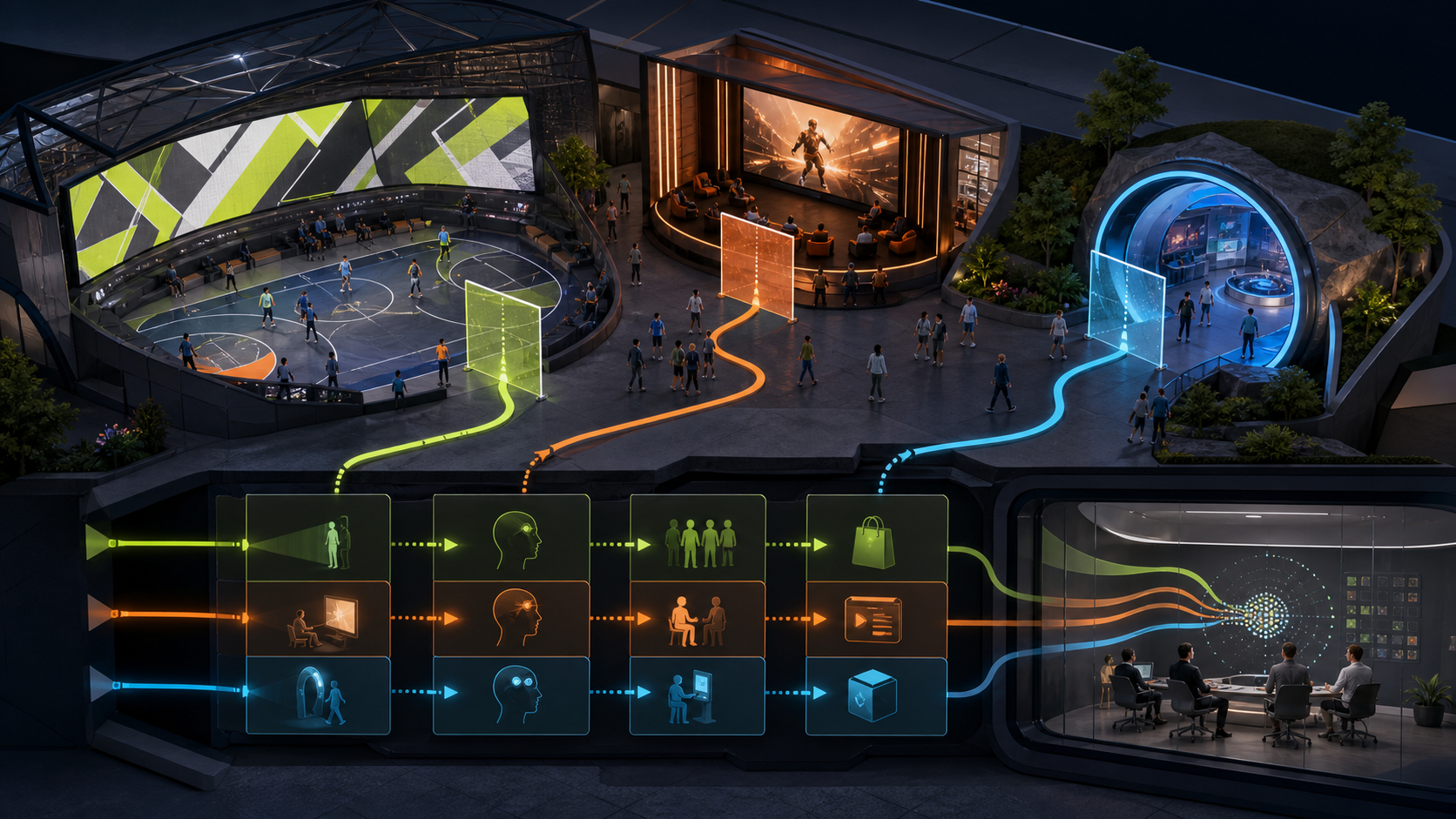
The activation is the source asset. The media system forms around it.
A player encounters the world through Home, Discover, Search, a sponsored unit, a friend or an external link. Inside, the player generates activity, social moments and possibly a portable item or creation. Creators interpret those moments for live and on-demand audiences. Clips are reposted. Communities explain strategies. Press and newsletters frame the launch for professional audiences. Some of that coverage sends new players back into the world.
This is a loop, not a funnel.
The operating implication is important. If the brief funds only the initial world build and opening-week promotion, it has funded the source asset but not the media property. Programming, creator enablement, moderation, community and measurement need owners after launch.
The channel frame needs more data, but not one giant engagement score. Keep the evidence layers separate so a decision-maker can see where performance was created and where it stopped.
| Layer | Management question | Representative evidence | Common error |
|---|---|---|---|
| Delivery | Did a valid opportunity reach the intended audience? | Qualified players, valid impressions, unique reach and frequency | Calling a place load an attended experience |
| Attention | Was there credible active presence in a branded context? | Active time, zone exposure, visual or survey evidence | Pricing every session minute as brand attention |
| Response | What did people choose to do? | Meaningful actions, creation, item use, invites and return | Adding unlike actions into one engagement total |
| Distribution | How did the experience travel? | Creator watch time, clips, referrals, social content and press | Using followers or outlet traffic as delivered reach |
| Outcome | What changed because exposure occurred? | Controlled brand lift, incremental search, conversion or sales | Inferring causality from participation alone |
| Economics | What did the channel cost and what comparable media did it create? | Build, operations and distribution cost; channel-specific media equivalents | Calling replacement cost revenue or ROI |
AMEC’s evaluation framework separates outputs, audience out-takes, outcomes and organizational impact. That sequence is useful here. The world and the media around it are outputs. Attention, understanding and interaction are audience responses. Preference, intent and advocacy are outcomes. Revenue or another organizational result is impact. A credible report does not jump from the first layer to the last.
The IAB Gaming Measurement Framework includes visitors, session duration, engagement, digital-good use, redemption and conversion among relevant measures for custom gaming formats. Those categories are a starting point. The reporting rules determine whether they become useful.
Qualified audience. Define the event that turns a join into a participant. This might be an active-time threshold, completion of the first meaningful action or entry into the measurable activation context.
Active experience time. Remove loading, disconnections and known inactivity. Keep total world time separate from time in which the brand or programmed experience is observable.
Meaningful action. Track choices that reveal effort or preference: optional quests, creation, customization, competition, cooperation, invites and item use. Do not weight them after seeing which result is largest.
Return behavior. Report Day 1, Day 7 and Day 30 cohorts when the intended lifecycle supports them. A short event may need a different return window, which should be stated before launch.
Social depth. Track parties, invitations, shared goals and creator activity. A crowded single-player experience and a socially recurring world produce different distribution potential even at the same visit count.
Roblox’s creator documentation places Day 1 retention and average session time before acquisition, then uses Day 7 and Day 30 retention to evaluate longer-term progress. Epic defines engagement through time played and return behavior, while Fortnite Discover evaluates average playtime, retention, quality play-through and social signals. The platforms make product quality part of the distribution system.
Off-platform media should be measured in the native unit that best represents its consumption.
For live creators, distinguish viewer-minutes and average concurrent audience from peak concurrency. For on-demand video, prefer valid watch time, average view duration, completion and unique viewers where available. For short-form content, record the platform’s exact view definition and campaign-period totals. For press, estimate readership of the relevant article rather than assigning the outlet’s entire monthly audience to one story.
Attribution also needs a rule. Exact campaign naming, distinctive assets, tracked links, creator agreements and temporal proximity can strengthen the connection. Generic mentions should not receive the same credit as content substantially about the activation.
Paid creator placements, brand-owned posting and earned amplification belong in separate fields. All may produce value. Calling all of them earned hides the actual cost of distribution.
| External layer | Prefer | Avoid |
|---|---|---|
| Live creator coverage | Viewer-minutes, average concurrency and attributable live window | Adding peak concurrency to cumulative VOD views |
| On-demand and short video | Period-isolated valid views, watch time, completion and deliberate interaction | Treating every start as equivalent attention |
| Community and UGC | Attributable posts, qualified consumption and original derivative work | Counting duplicate reposts as independent creations |
| Editorial and press | Relevant stories with conservative article-level readership | Crediting full outlet traffic to one article |
| Referral | Tracked links, share paths and downstream player quality | Reporting clicks without qualified plays or retention |
It is tempting to say that a ten-minute game session is worth a fixed number of video views. That shortcut is easy to present and difficult to defend.
The IAB and MRC attention framework treats attention as a complementary signal, not a replacement for exposure and outcomes. MRC outcome standards also caution that duration should not be used alone as a measure of effectiveness because the relationship between time and effect cannot be assumed to be linear.
Different moments carry different value. Two minutes spent choosing a branded design can create stronger evidence than ten minutes of unrelated traversal. Six seconds of a clearly branded video may create a different opportunity from six seconds before the brand appears. Context, agency, creative structure, repetition and audience intent matter.
The comparison should therefore preserve the channels:
Channel contribution=qualified native evidence valued against a relevant market comparable, with quality and overlap controls
The comparable creates a planning lens. It does not make a game minute and a video second the same experience.
This is the logic behind ROLearn’s OMNI-EMV architecture. Each layer is measured in its native unit, normalized only after qualification and reported with a range and evidence grade.
Media properties create another reason to pay attention. In a virtual world, that reason may be an update, live event, social commitment, new collection, competitive season or creator-led format.
Retention measures whether the audience accepted the invitation. It should be read by cohort and version. A blended curve can fall when a large media burst brings colder players even if the experience did not change. Compare users who arrived under similar conditions, then examine which release, source and social context produced stronger return.
The reporting window should match the programming promise:
A media-channel report should make a stronger business conversation possible, not replace it with a larger proxy number.
Brand lift needs an exposed and unexposed comparison or another defensible counterfactual. Search, site visits and commerce need attribution windows and a view of what would have happened anyway. Revenue needs costs, incrementality and clear boundaries before anyone calls the result return on investment.
Platform research can inform expectations but should not be pasted in as a campaign result. Roblox and Ipsos reported a 2026 survey comparing 200 Roblox users aged 13 to 34 with equal-sized streaming and social-platform samples. Roblox reported stronger perceived attention and involvement among the surveyed Roblox users. That is a useful platform-level hypothesis. It is not proof that every branded world generates lift, nor that self-reported attention equals observed campaign impact.
The executive view should contain separate ledgers:
Treating a game as a media channel changes who works after launch.
Before the brief, define the audience relationship, lifecycle and business decision. Decide whether this is a finite event, a repeatable program or a persistent property.
Before production, define qualification, exposure, cohort and outcome rules. Instrument the core loop, branded context, social actions, item use, referrals and return behavior. Establish the counterfactual before it becomes impossible.
Before launch, connect world telemetry, creator agreements, social listening, press discovery, paid-media data and downstream outcomes to a common campaign identity and measurement window.
During operation, review acquisition quality, first-session drop-off, meaningful actions, retention and emerging media together. Ship fixes and programming against diagnosed behavior, not stakeholder intuition alone.
After paid media ends, keep measuring for the period promised in the brief. Close with a decision: continue, update, reposition, archive or expand the property.
Qualified players, active experience evidence, meaningful actions, social behavior, item use and cohort return.
Creator and social consumption, derivative content, press, referrals and paid versus earned distribution.
Audience overlap, evidence quality, benchmark versions and uncertainty preserved through aggregation.
Brand and business effects reported with their own counterfactual, attribution window and limitations.
Analysis and source architecture reviewed 10 August 2026. Platform definitions and discovery systems can change and should be versioned in campaign reporting.
The media-channel frame is more complete than campaign counting. It is not a license to inflate.
Not every world becomes a channel. Many activations are finite experiences whose value is concentrated around a launch. Their measurement should match that purpose.
Presence is an upper bound. First-party telemetry can show activity, but it cannot establish conscious brand attention without a stronger method.
External discovery is incomplete. Private communities, untagged content, deleted posts and closed analytics create blind spots.
Audience overlap is partly modeled. Privacy and platform boundaries limit cross-media identity. Gross reach should not be relabeled unique reach.
Platform evidence has incentives. Platform research can be useful and well designed while still coming from a party that benefits from channel investment. Read methods and samples, and seek campaign-specific validation.
Definitions move. View rules, discovery systems, analytics fields and payout programs change. Reports need dates and versioned metric dictionaries.
Media value is not business value. Replacement-cost estimates explain a media contribution. They do not prove incremental revenue, profit or long-term brand equity.
The practical shift is not to call the activation a channel in the pitch. It is to fund and operate the parts that make the claim true.
| Treat it as a media property when | Treat it as a campaign asset when |
|---|---|
| There is a programmed reason to return | The experience is intentionally finite |
| A team owns updates, community and measurement | The organization will not operate it after launch |
| Player behavior can influence future discovery | Reach is almost entirely purchased for a fixed window |
| Creators and communities can extend the story | The message must remain tightly controlled and unchanged |
| The audience relationship matters beyond one exposure | A single reveal or redemption is the complete objective |
If the property test is passed, the budget should include programming, operations, creator enablement, community, safety and longitudinal measurement. If it is not passed, keep the campaign frame and measure the finite objective well. Both are legitimate strategies. Confusing them is what wastes money.
If the team cannot answer these questions, it has a launch plan, not yet a media-channel strategy.
Games are becoming media channels because they can do more than display a message. They can program attention, form communities, produce distribution and earn another session. The measurement system should reflect that richer role without confusing depth with causality or media equivalence with return.
For the framework that values the media generated inside and around an activation, read Beyond Visits: Earned Media Value for Virtual-World Brand Activations.
Tu Dang. "Games Are Becoming Media Channels. Brands Still Measure Them Like Campaigns.." ROLearn Intelligence, August 2, 2026. https://intelligence.rolearn.dev/analysis/games-are-becoming-media-channels

Tu Dang
Founder of ROLearn
I study how games become businesses, media channels, and virtual economies.
View author profile →One decisive insight on games, brands, and virtual worlds, every Thursday.
Tu Dang
Founder of ROLearn
I study how games become businesses, media channels, and virtual economies.
One decisive insight on games, brands, and virtual worlds, every Thursday.