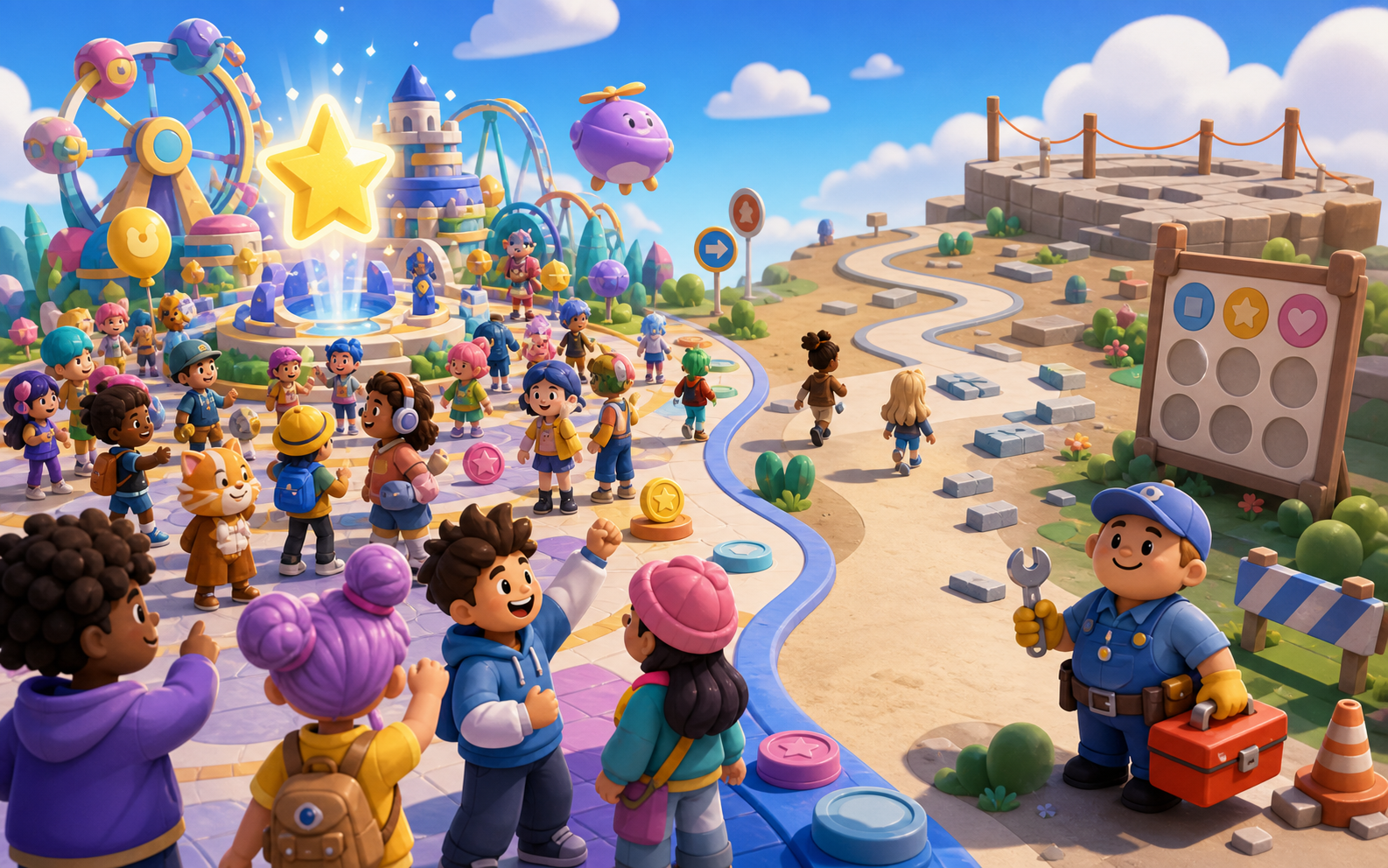
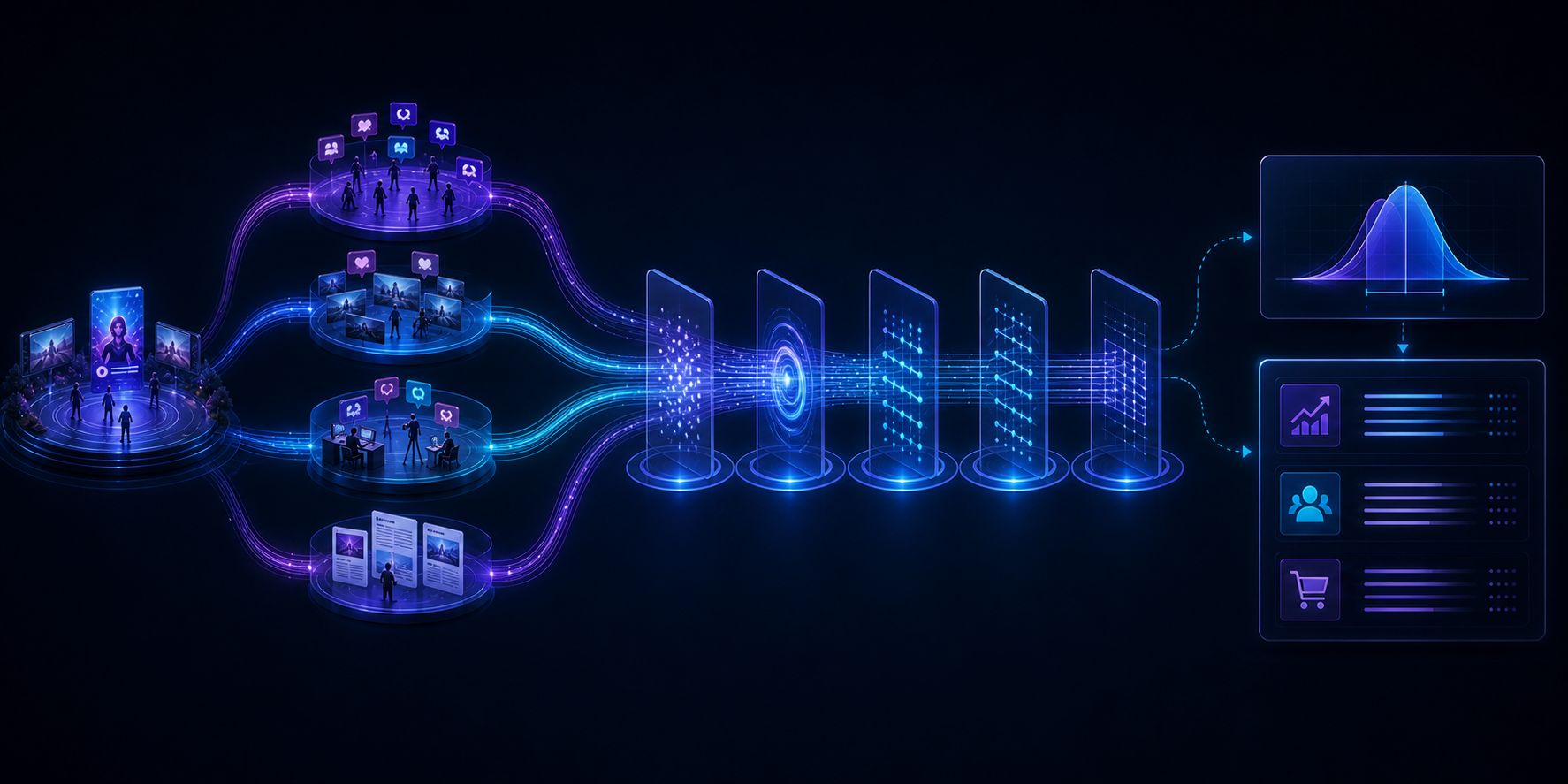
UGC Economies Are the New Distribution Channels
In a creator platform, the most powerful media unit may be something another person can build with, wear, remix or carry into a different community.
Analysis by Tu Dang · Founder of ROLearn
Published · Updated · 9-minute read

Key findings
- UGC turns product supply into distribution: each legitimate reuse can place an asset, mechanic or IP in front of another creator's audience.
- Reusable value travels farther than visual novelty. Creator utility, clear rights and low integration cost determine adoption.
- A sealed branded world and a creator kit serve different jobs. The strongest programs often use the destination as proof and the kit as the distribution layer.
- Measure the derivative network over time: qualified creators, published uses, audience reached, retention, quality, rights compliance and economic participation.
Most brand teams enter a virtual world with a destination in mind. Build the place, publish the place, buy traffic to the place. It is the campaign-microsite model translated into 3D.
Creator platforms offer a more interesting possibility. Instead of asking every audience to come to one brand-owned world, give thousands of creators something worth carrying into theirs.
That “something” could be an avatar item, an asset pack, a mechanic, a challenge format, a licensed character system, a sound, a template or a piece of code. If it helps creators make better work, each use becomes both content supply and a new point of distribution.
This is not free reach. It requires product thinking, rights infrastructure, moderation, creator economics and patient measurement. But it changes the unit of strategy from a place people visit to a capability the ecosystem can reuse.
Why UGC behaves like distribution
Roblox’s Creator Store contains millions of assets from Roblox and independent creators, including models, plugins, scripts, interfaces, audio and visual effects that can be reused in games. Its separate avatar Marketplace lets users buy items for a platform-wide identity. Roblox now also operates licensing tools through which eligible rights holders can publish terms and creators can request to build games around approved IP.
These are not merely storefronts. They are routing systems. They connect one creator’s supply to another creator’s production and audience.
Fortnite’s ecosystem shows the other side of the loop. Discover continuously evaluates islands using attraction, playtime, retention, quality play-through and social signals. Engagement payouts reward eligible publishers based on player activity and acquisition. A creator who turns an asset or format into a good experience can receive more distribution and economic participation. The platform therefore links creation, player response, discovery and earnings.
In a UGC economy, distribution is not only where content is promoted. It is what happens when useful content becomes an input to somebody else’s work.
The destination and the distribution layer
A destination is still valuable. It can stage a reveal, establish quality, deliver a controlled narrative and give creators something credible to respond to. The mistake is assuming the destination must carry the entire strategy.
Think of the program as two connected products:
The flagship experience proves the creative idea. It gives the brand a canonical place, high production value, instrumentation and a direct community relationship.
The creator layer decomposes the idea into approved, useful parts. It gives other creators freedom to make experiences that fit their audiences while preserving rights, safety and attribution.
The flagship launches the story. The creator layer allows the story to branch.
| Output | Creator utility | Distribution behavior | Primary risk |
|---|---|---|---|
| Branded destination | A complete place to play or visit | Concentrates audience at one URL or island | Audience decays when paid and creator support ends |
| Portable identity item | Self-expression across eligible contexts | Travels with the player and appears in social play | High redemption with low sustained use |
| Asset or mechanic kit | Reduces build time or adds a useful system | Appears inside multiple creator experiences | Low adoption if integration is difficult |
| Challenge or format | A repeatable content prompt | Produces videos, streams and derivative game modes | Repetition without genuine variation |
| Licensed IP | Recognizable characters, settings or rules under approved terms | Lets creators serve established fan communities | Rights, quality and brand-safety failure |
| Creator collaboration | Funding, access and amplification | Transfers trust through a creator's existing audience | Paid reach mislabeled as organic distribution |
Utility is the creative brief
Brands usually optimize an asset to be admired. Creators need it to be used. That changes the questions asked during development.
- Can it be integrated without rebuilding the creator’s project?
- Does it improve play, identity or production speed?
- Is there room for meaningful variation?
- Are the rights and commercial terms understandable?
- Can audiences recognize the IP without every use looking identical?
- What happens when the platform or engine updates?
A beautiful object with high polygon cost, unclear permissions and no behavior may perform well in a trailer and poorly as creator infrastructure. A modest kit with reliable code, clear documentation and flexible art direction can generate far more durable reach.
This is why control has to move from approving every output to designing a safe system. Define immutable elements, flexible elements, prohibited uses, moderation rules, attribution, revenue share and removal procedures. Then give creators enough agency to make work their audience would choose.
The UGC distribution loop
- 1Release
- Useful asset
- Clear license
- Creator economics
- Documentation
- 2Adopt
- Qualified creators
- Low integration cost
- Creative freedom
- Support
- 3Publish
- New experiences
- Items and formats
- Creator media
- Community contexts
- 4Respond
- Playtime
- Retention
- Item use
- Shares and remixes
- 5Reinvest
- Creator earnings
- Updates
- New variants
- Broader supply
Platforms increasingly reward the behaviors in this loop. Roblox’s Creator Rewards, for example, links qualifying engagement and new or reactivated-user acquisition to creator earnings under stated rules. Epic’s engagement system links player activity, return and acquisition to a shared payout pool. The exact programs change, which is why contracts and forecasts need version dates. The strategic direction is clear: creators are compensated for making content that adds audience and keeps it active.
Roblox reported more than $1 billion in DevEx creator earnings from March 2024 through March 2025, a platform-reported figure that demonstrates economic scale but not equal opportunity. Most creator markets are highly uneven. A brand strategy should not assume that publishing a kit creates adoption or that every creator has comparable distribution.
Measure the branches, not just the trunk
The campaign window is often too short for a creator strategy. Discovery, integration, production, moderation and audience growth occur on different clocks. A derivative experience may find its audience after the flagship media has ended.
Track the network in layers:
- Supply: approved assets, formats, licenses and versions released.
- Adoption: qualified creators who download, license, test and publish.
- Derivative output: live experiences, items, videos and updates using the work.
- Audience: deduplicated reach, qualified play, attention and return across derivatives.
- Quality: ratings, retention, safety incidents, removals and rights compliance.
- Economics: creator earnings, brand-funded support, revenue share and reinvestment.
- Durability: active derivatives and continued item use after 30, 60 and 90 days.
Do not count every download as distribution. A download can be curiosity. A published use can still have no audience. The strongest evidence chain moves from access to integration, from integration to publication, and from publication to qualified audience response.
What a brand should ship
Begin with one creator job, not a library of promotional objects. A fashion IP might help creators design identity and social status. A sports brand might provide a reliable competition system and replayable challenges. An entertainment IP might license a world, character set and narrative rules to studios already serving the right fan communities.
Then build the smallest complete distribution product:
- a useful, technically tested asset or mechanic;
- a plain-language license and attribution rule;
- examples that demonstrate range without prescribing every output;
- economics that reward the creator for audience value;
- moderation and escalation paths;
- versioning, analytics and a real support owner.
Launch it with a small group of creators who differ in genre, audience and production scale. Watch what they misunderstand, remove and change. Those changes are product research. Broaden access only after the kit survives contact with real projects.
The strategic shift
The traditional distribution question is “how much media should we buy for the thing we made?” The creator-economy question is “what should we make so the ecosystem has a reason to distribute it?”
The answers lead to different budgets. More goes to interoperability, documentation, rights, creator economics, support and measurement. Less depends on a single opening weekend.
A branded world can still be the center of the program. It just should not be the edge. When creators can build with the idea and players can carry it into other contexts, the activation stops behaving like a temporary destination and starts behaving like a distribution system.
Sources
- Creator Store, Roblox Creator Hub (accessed August 10, 2026)
- Marketplace Overview, Roblox Creator Hub (accessed August 10, 2026)
- IP Licensing for Creators, Roblox Creator Hub (accessed August 10, 2026)
- Creator Rewards, Roblox Creator Hub (accessed August 10, 2026)
- Annual Roblox Economic Impact Report, Roblox (accessed August 10, 2026)
- How Discover Works in Fortnite, Epic Games (accessed August 10, 2026)
- Engagement Payout in Fortnite Creative, Epic Games (accessed August 10, 2026)
Cite this piece
Tu Dang. "UGC Economies Are the New Distribution Channels." ROLearn Intelligence, July 24, 2026. https://intelligence.rolearn.dev/analysis/ugc-economies-new-distribution-channels
About the author
Tu Dang is founder of rolearn. Tu Dang is the founder of ROLearn, a market-intelligence platform used by developers, studios, and brand teams working inside virtual worlds.