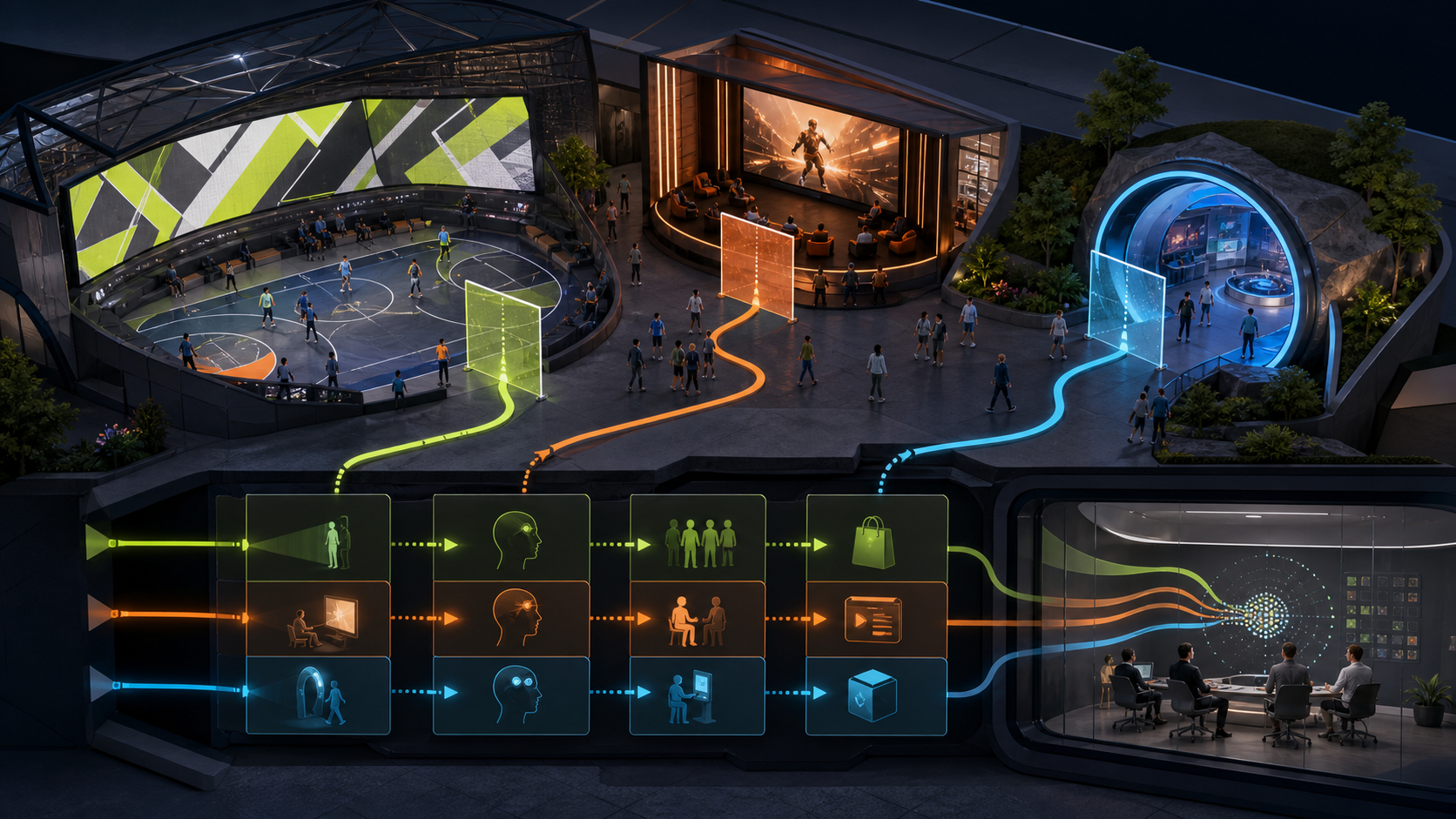
In-Game Advertising Measurement: From Exposure to Outcomes
·17 min read
A buyer's framework for Roblox analytics, player retention, campaign measurement, market intelligence and the data infrastructure required to connect them.
By Tu Dang · Founder of ROLearn
· 14 min read · Updated
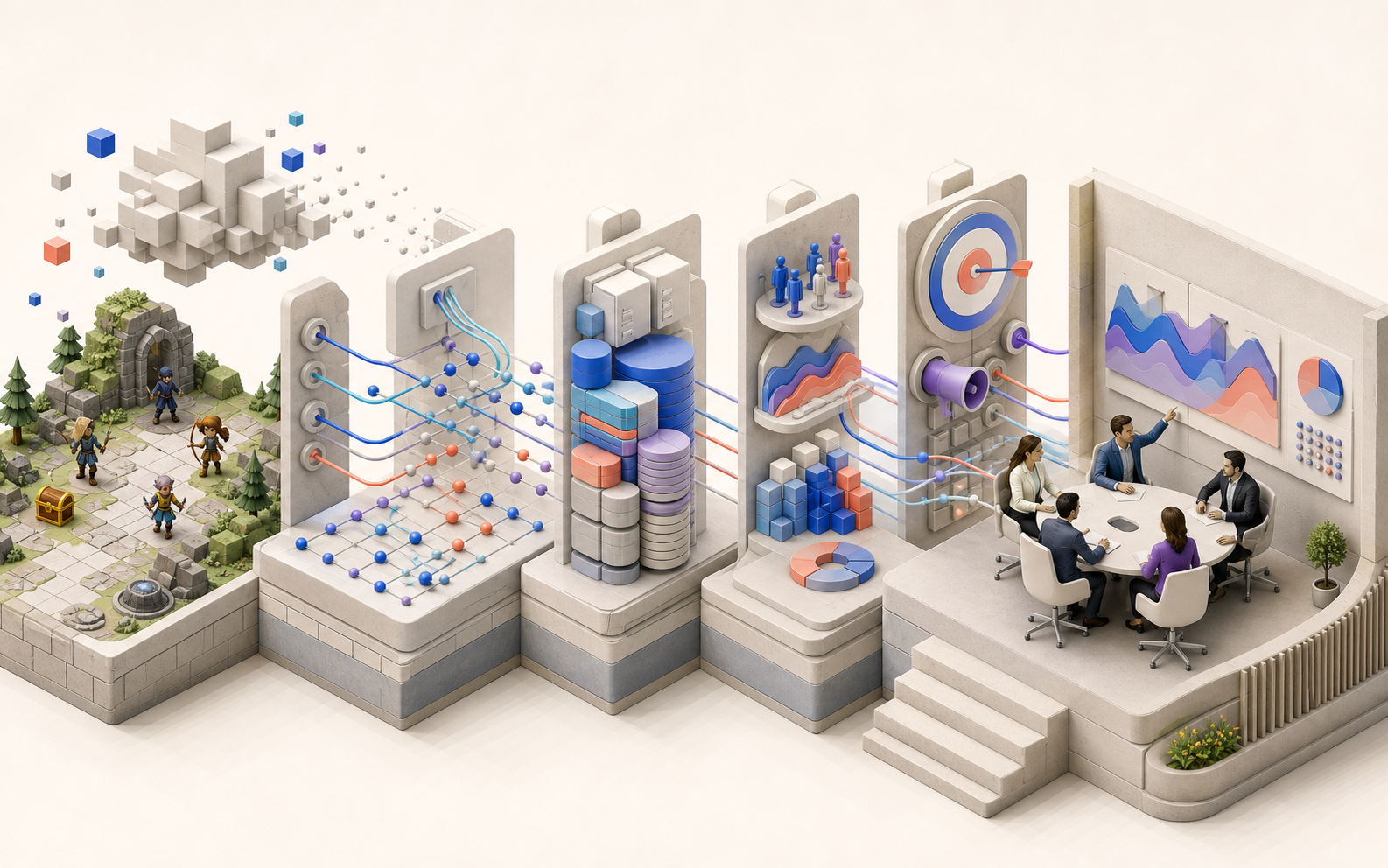
A studio asks for a better retention dashboard. A brand asks for Roblox campaign ROI. An agency asks for cross-channel reach. Procurement writes “gaming analytics platform” across the top of the same request for proposal.
Those teams are not buying the same thing.
The phrase gaming analytics software covers product analytics, platform dashboards, attribution, market intelligence, social listening, brand-lift research, data warehouses and executive reporting. A tool can be excellent at one layer and incapable of answering the next. The expensive mistake is buying a polished interface before agreeing on the decisions, definitions and data rights underneath it.
This report provides a buyer’s architecture. It does not publish a vendor league table. It shows what a brand, agency or studio should measure, where Roblox and Fortnite native analytics fit, and which claims require evidence outside a gaming platform.
There are at least five products hiding inside the phrase gaming analytics platform.
A studio may need to know which onboarding step predicts D1 retention. A brand may need to know whether a Roblox activation lifted consideration. An agency may need deduplicated reach across creators, paid media and the virtual world. An investor may need comparable evidence across a portfolio.
One dashboard can display the answers. It cannot create evidence its source systems never observed.
For a complete platform-specific operating model, use ROLearn’s Roblox analytics guide. It connects native dashboards, custom events, funnels, cohorts, experiments and API access to the decisions a studio or brand team actually owns.
The Roblox analytics dashboard covers engagement, retention, acquisition, demographics, feedback and monetisation. Eligible experiences can filter, export, benchmark and examine KPI breakdowns. Roblox Analytics Home can also monitor multiple games and expose a smaller public stat set for experiences where the viewer lacks private analytics permission.
The Roblox Analytics API, formally documented as the Roblox Analytics Query API, extends that foundation. Current documentation describes aggregated queries for metrics including daily active users, revenue and retention, with date ranges and dimensions such as platform, country and age group. It requires an API key and appropriate universe analytics permission. Standard and performance metrics also have different historical availability.
Those details matter in an enterprise architecture:
Epic’s Project Analytics provides the equivalent starting layer for Fortnite islands: impressions, clicks, plays and engagement evidence from major in-client sources. Discover documentation adds context about the signals that influence visibility, including playtime, retention, bounce, quality and social play.
Native analytics are indispensable because the platform controls the identity and event context. They are incomplete because the platform does not observe every off-platform creator exposure, brand perception or commercial event.
ROLearn maintains the relevant first-party documentation and measurement standards in its virtual-world measurement source tracker, so a buyer can verify what each source actually covers before accepting a platform claim.
Platform dashboards show standard metrics. Product analytics explains the specific game.
The implementation should instrument onboarding, progression, economy, social behaviour, content adoption and failure states. Event names need version control and stable properties. A funnel should distinguish an optional choice from a required click. A retention cohort should preserve first-play date and acquisition source.
This is where a generic mobile game analytics platform can be useful. Mobile game analytics software often has mature acquisition, funnel, cohort, experimentation and monetisation workflows. The buyer should still test fit for a persistent virtual world:
The familiar product does not automatically have the right ontology.
The dedicated player retention analytics framework defines the cohort and return rules, diagnosis ladder, version controls and weekly live-ops workflow behind D1, D7 and D30.
Searches for player retention analytics often lead to D1, D7 and D30 dashboards. Those metrics are useful. They are not the diagnosis.
A strong system connects cohort return with:
Roblox’s retention documentation uses first-play cohorts and provides daily and weekly views. Its acquisition documentation connects sources with downstream retention, playtime, payer conversion and revenue. A buyer should preserve that relationship rather than exporting each KPI into a separate slide.
| Question | Metric | Required segment | Decision |
|---|---|---|---|
| Did acquisition attract the right players? | D1 and cumulative playtime | Source and campaign cohort | Reallocate acquisition |
| Did onboarding deliver the core value? | First-session funnel and D1 | Device, performance and new users | Repair onboarding |
| Is progression sustaining return? | D7 and content depth | Start-date cohort and version | Change progression or rewards |
| Is the live game retaining mature players? | D30 and reactivation | Player age and update exposure | Plan live operations |
| Does retention create economic health? | Revenue per acquired user | Source, payer status and geography | Change spend or monetisation |
Acquisition is not complete at the click. The system should connect impressions, share links, creator posts, portal ads, search ads and other sources with qualified plays and later cohort quality.
For a brand activation, marketing data also extends beyond the game. Creator video, social content, press coverage and player-made media can reach a larger audience than the world itself. The system needs attributable content discovery, native channel metrics and audience-overlap handling.
This is where many “all-in-one” platforms become a spreadsheet. The tool may ingest totals but cannot explain whether a creator view was paid or earned, whether the same person also visited the world, or whether a press mention was relevant to the campaign.
Active time and meaningful actions are valuable behavioural evidence. They do not establish awareness, recall, favourability or purchase intent.
The IAB gaming framework and broader attention and outcomes standards reinforce the need to distinguish delivery, exposure, attention and effect. A brand measurement layer may require:
Gaming audience insights also need a declared universe. “Roblox players” could mean global daily active users, monthly users in an age band, qualified campaign visitors or survey respondents. Those populations cannot be exchanged without qualification.
Teams searching for gaming market research companies may need market size, audience behaviour, competitor tracking, platform policy, category benchmarks or investment diligence. None is a substitute for first-party game analytics.
Market intelligence should label:
Good game benchmarking is similarly specific. Roblox provides similar-experience benchmarks for eligible creators, but its documentation states those benchmarks are a comparison aid rather than a direct discovery input. An external benchmark needs the same discipline: named peer logic, metric definition, window and coverage.
Search demand for earned media value calculator and earned media value formula reveals a real buyer need: leadership wants unlike media outputs expressed in one comparable view.
The dangerous calculator accepts followers, impressions and engagement, applies a hidden rate and returns a precise currency value. It usually leaves five questions unanswered:
Defensible media value=Channel-native evidence + comparables + quality and overlap controls
This is an architecture, not the proprietary executable OMNI-EMV formula or its coefficients.
The output should be a range and evidence grade. Direct brand lift, sales and strategic value remain outside the media-equivalence total. For the complete architecture, read Beyond Visits.
The RFP should score capability against the team’s decisions.
| Requirement | Studio priority | Brand or agency priority | Evidence to request |
|---|---|---|---|
| Native platform coverage | Roblox, Fortnite or target platform depth | Campaign exposure and audience eligibility | Live connection and definition catalogue |
| Event instrumentation | Onboarding, progression, economy, live ops | Branded zones, objects and meaningful actions | Event plan and QA log |
| Identity and cohorts | New, returning and reactivated players | Privacy-safe exposure and overlap | Identity diagram and match-rate reporting |
| Retention analytics | D1, D7, D30 and mature cohorts | Return after campaign or content updates | Cohort recreation from source data |
| Attribution | Acquisition source to downstream value | Paid, creator, social, press and in-world paths | Attribution rules and unattributed share |
| Experimentation | Feature and economy tests | Lift and incrementality designs | Assignment, controls and power approach |
| Benchmarking | Comparable games and versions | Comparable media and campaign types | Peer definition and coverage |
| Data access | Warehouse, API and export | Agency, brand and studio permissions | Contractual ownership and exit export |
| Governance | Metric versions and lineage | Suitability, geography and outcome controls | Dictionary, audit log and named owner |
Add service requirements: latency, uptime, support, implementation responsibility, data residency, retention periods, security review and incident response. A platform can have the right charts and the wrong operating model.
Buy when a well-defined product covers a repeated need and its data can leave the system. Acquisition, standard product analytics, survey operations and media monitoring often fit this case.
Build when the decision depends on proprietary events, identity, economics or workflow. A studio’s progression model or a brand’s cross-campaign definition layer may become strategic infrastructure.
Combine in most enterprise cases. Use Roblox or Fortnite native analytics for platform truth, instrument the proprietary player journey, centralise governed data, and add specialist research for brand or business outcomes. The executive layer then reads from several evidence systems without pretending they are one source.
The integration cost belongs in the buying decision. A less expensive tool that creates manual reconciliation every week may have a higher total cost than a system with stronger access and lineage.
Do not let the vendor choose the story. Provide one scenario:
A creator campaign drives players into a Roblox activation. Leadership wants qualified reach, player retention, brand lift, earned media value and incremental sales by market.
Ask the vendor to:
The demonstration reveals more than a feature grid because it tests the seams where gaming analytics systems usually fail.
The executive view should not mirror the warehouse. It should answer four questions:
Every headline metric needs its comparison, coverage and owner. A trend without a decision is monitoring. A number without lineage is decoration.
Nine primary platform documents and industry measurement frameworks.
Platform, product, marketing, brand and business evidence for enterprise buyers.
No vendor was tested, scored or endorsed; this report evaluates requirements.
Prefer transparent definitions, access and governance over an unexplained composite score.
Capability review current through 12 August 2026. Platform features and access conditions should be revalidated during procurement.
The best gaming analytics platform is the system that produces reliable evidence for your decisions and leaves a clear path back to the source.
ROLearn Intelligence evaluates the evidence architecture. Teams evaluating an operating system can explore ROLearn’s analytics platform and services.
Tu Dang. "Gaming Analytics Platforms: What Brands and Studios Actually Need." ROLearn Intelligence, August 9, 2026. https://intelligence.rolearn.dev/research/gaming-analytics-platforms-brands-studios

Tu Dang
Founder of ROLearn
I study how games become businesses, media channels, and virtual economies.
View author profile →One decisive insight on games, brands, and virtual worlds, every Thursday.
Tu Dang
Founder of ROLearn
I study how games become businesses, media channels, and virtual economies.
Choose the right measurement stack
ROLearn helps brands and studios identify the decisions, evidence gaps and integrations their gaming analytics stack actually needs.
One decisive insight on games, brands, and virtual worlds, every Thursday.